
Anyway, the Parkside school staff told me that I just HAD to go visit the inspirational gardens at one of our partner primary schools. So I made my appointment and trotted off excitedly to Spire Infants School to meet their gardener, Valerie, have a tour round their wonderful gardens and take part in one of their 5 gardening clubs! You can have a look at their website here: http://www.spire-inf.derbyshire.sch.uk/ , but be aware that some of the garden photos on the website are 2 or 3 years old now, but they show where the gardens started from.
Valerie is funded by school to run all the gardening clubs and a wide range of gardening projects throughout the school. She does 2 clubs at lunchtimes and 3 After-School clubs and is supported by a whole range of staff in different ways depending on the project at the time. The clubs run from February to November regardless of the weather. There are roughly 22 Y2’s and 15-18 Y1’s (5 and 6 year olds) mixed across the 5 different sessions. Younger children in the Reception class aren’t involved in gardening club, but do have gardening sessions at other times.
I started with the tour of the gardens – VERY impressive. Here is the fruit garden with a variety of fruit trees creating a boundary, then raspberries, strawberries, redcurrants etc in the middle beds.

Each year group has a raised bed which this year included onions, cabbage, beetroot, courgette and radishes. There are also potato buckets per year group and a general bed with cabbages in. There are some beautiful Canna Lilies growing by the small greenhouse and the most beautiful variegated ornamental sweetcorn plants that I’d never seen before and instantly fell in love with!

More of the year group beds.

I started with the tour of the gardens – VERY impressive. Here is the fruit garden with a variety of fruit trees creating a boundary, then raspberries, strawberries, redcurrants etc in the middle beds.

Each year group has a raised bed which this year included onions, cabbage, beetroot, courgette and radishes. There are also potato buckets per year group and a general bed with cabbages in. There are some beautiful Canna Lilies growing by the small greenhouse and the most beautiful variegated ornamental sweetcorn plants that I’d never seen before and instantly fell in love with!

More of the year group beds.

Each class’s bed is carefully labelled and equally carefully nurtured and tended.

The storage shed and flower beds. All the tools are kept securely in the shed as they are proper tools, not the namby-pamby blunt ‘kids tools’ you often find, which are actually useless and don’t help the children to learn how to garden.

Flowers in the cold frames ready to be planted out. Even the Reception children (4+years) grow things. This year they’re growing 3 different coloured sunflowers and short sunflowers.

Next I went into the huge Keder greenhouse to see what was going on in there. 2/3rds of the greenhouse is growing space and 1/3rd is activity space because the children work in all weathers and use the activity space in the greenhouse when the weather is bad.


The day I went, the gardening club were digging up, washing and weighing potatoes for the Potato Council ‘potatoes for schools’ competition. The variety and number of plants was set by the council and the school with the biggest crop gets a prize.
Listening to the instructions.


The storage shed and flower beds. All the tools are kept securely in the shed as they are proper tools, not the namby-pamby blunt ‘kids tools’ you often find, which are actually useless and don’t help the children to learn how to garden.

Flowers in the cold frames ready to be planted out. Even the Reception children (4+years) grow things. This year they’re growing 3 different coloured sunflowers and short sunflowers.

Next I went into the huge Keder greenhouse to see what was going on in there. 2/3rds of the greenhouse is growing space and 1/3rd is activity space because the children work in all weathers and use the activity space in the greenhouse when the weather is bad.


The day I went, the gardening club were digging up, washing and weighing potatoes for the Potato Council ‘potatoes for schools’ competition. The variety and number of plants was set by the council and the school with the biggest crop gets a prize.
Listening to the instructions.

Searching for potatoes.

Many of the children were very limited about what they were prepared to eat before the gardening project started, but will now try new foods.

Once the children had gone home Valerie told me more about the project and how they link it into the National Curriculum and the school timetable:
Every September there is a whole school gardening project so, for example, in 2008 everyone was involved in planting 50 trees in the school grounds as part of the national Breathing Spaces project. They have also done mass bulb plantings of narcissi and daffodils. This year they’re doing a potato project with every class growing a tub of potatoes, which will be counted and weighed in maths numeracy lessons before being eaten – a whole school version of today’s potato project really.
Planting swede seeds. The swedes will be used to make winter vegetable soup in a cookery lesson in the January/February half term.

The gardening groups hold a plant shop 2 or 3 times each term to sell surplus plants to fund more seeds etc. The Y2’s do all the money handling, adding up the bills, giving out correct change etc – but because it’s fun they don’t realise they’re learning maths by stealth!
Valerie also goes into class lessons and whole school assemblies to do demonstrations and get the children involved with planting and growing. She also involves the children in hard landscaping. So far they have made paths, spread gravel, built bat boxes and hedgehog houses and planted fruit trees – not bad for 4 to 6 year olds!
I asked Valerie about selling the produce to the kitchens on a regular basis. They do supply them with salad leaves, chives, onions, leeks, cabbage and rhubarb in season but they can’t yet sell to the kitchens because:
• Our beloved (?!) County Council who we buy the kitchen services from cannot work out how to charge for the produce from a different supplier (i.e., not them!).
• Apparently neither can they work out how to deduct that cost and amount of fresh produce from the food they supply to school!
• The kitchen staff would love to have the fresh produce as all the food supplied comes ready prepared and chilled or frozen but they don’t have time to prepare fresh vegetables within their allocated hours.
• The lack of fresh food preparation is deskilling our kitchen staff … a HUGE bone of contention for many people.
• There isn’t the funding available to pay for the increase in the kitchen staff’s hours to allow for fresh food prep time.
And, of course, the knock-on effect is that the children don’t often see the follow-through from seed to plant to kitchen to plate, not do they get to taste the difference in home grown food versus supermarket or fast food outlet cook/chill foods, so it’s a constant uphill battle to move many children and families onto healthier and cheaper diets and away from fish & chips (fries) onto fruit and vegetables!
Picking strawberries.

I’ll come down off my high horse now and explain about the rest of the garden projects down at Spire!
When Valerie was an RHS student in 2004, she approached school for permission to do a 200 hour horticultural project there as part of her course. Jane - the inspirational Head Teacher there, being a very canny woman gave permission for Valerie to do the project as long as she completed it! The whole project took closer to 400 hours!

I’ll come down off my high horse now and explain about the rest of the garden projects down at Spire!
When Valerie was an RHS student in 2004, she approached school for permission to do a 200 hour horticultural project there as part of her course. Jane - the inspirational Head Teacher there, being a very canny woman gave permission for Valerie to do the project as long as she completed it! The whole project took closer to 400 hours!
Valerie designed and constructed (with a little help from a builder for the hard landscaping) a secret garden, a gravel garden, a woodland garden and a bog garden – no mean feat in ground that is almost pure clay!
The secret garden was the first area to be constructed in 2005. It is 3 areas within 1, separated by arches and bowers. Despite having the school on one side and a car park on the other, it feels a very quiet, calm, restful space. The 3 areas each have their own colour scheme in amongst the riot of greenery. The children are accompanied by staff when using this area.

‘The Little House’ was added in October 2005 and its roof incorporates a wooden beam and an old bench from the old school hall which was being demolished around that time.

I forgot to take a photo of the woodland garden as I was too busy looking at the hedgehog house under the shrubbery, but this photo shows the bog garden and the gravel garden, which began in 2006. they are in raised beds as the clay was just so dense it was almost impossible to dig out!

Part of the gravel garden.
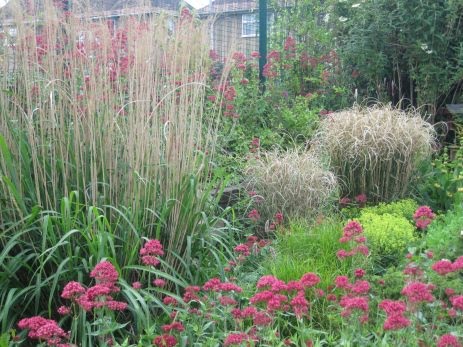
The school has entered and won the East Midlands in Bloom schools category three times – and won each time! They were also one of three winners of the Garden Organic competition in 2008 – and I’m sure you’re able to see why they won!
The gardens in Spire Infants School and Parkside Community Secondary School are all very different, but equally inspirational in their own ways and I feel very privileged to be able to access them all …. I just need to borrow Valerie for a year to help me in my own garden now because she has inspired me to bigger and better things!
I feel another plan coming on…………!
